
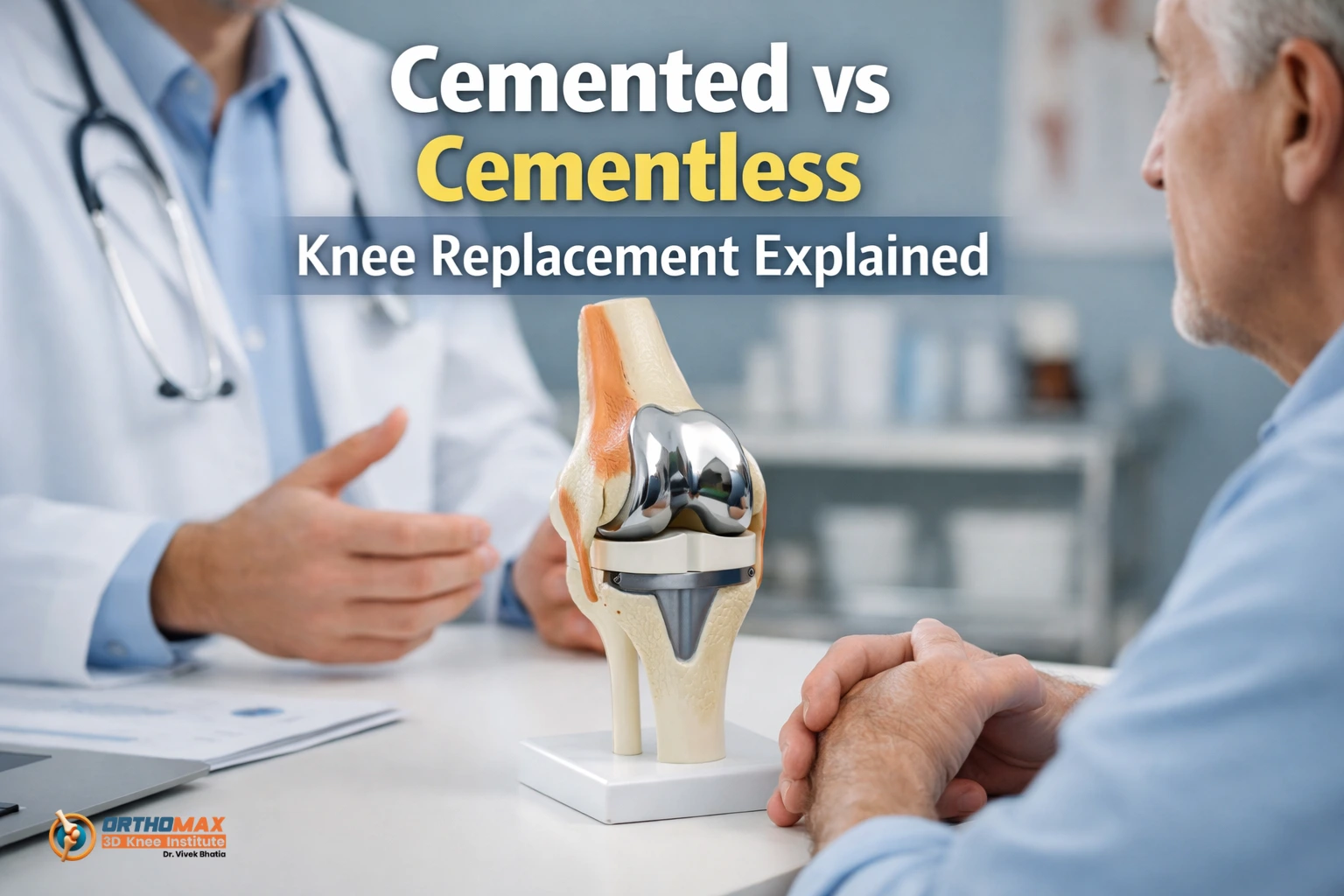
Cemented vs Cementless Knee Replacement Explained
Knee replacement surgery has transformed the lives of millions of people suffering from chronic knee pain caused by arthritis, injury, or joint degeneration. Modern surgical techniques and implant designs now offer highly successful outcomes with long-lasting relief. However, many patients preparing for surgery often hear terms like cemented and cementless knee replacement and feel confused about what they actually mean.
Understanding the difference between these two fixation methods can help patients make informed decisions along with their orthopaedic surgeon. This guide explains cemented vs cementless knee replacement, how each works, their advantages, limitations, and which option may be best for different patients.
What Is Knee Replacement Surgery?
Knee replacement, also called total knee arthroplasty, is a surgical procedure in which damaged cartilage and bone in the knee joint are replaced with artificial components made of metal, plastic, or ceramic materials.
The goal of surgery is to:
- Reduce chronic knee pain
- Restore mobility and joint function
- Correct deformity
- Improve overall quality of life
One of the most important steps during surgery is fixing the implant securely to the bone. This is where cemented and cementless techniques differ.
What Is a Cemented Knee Replacement?
In a cemented knee replacement, the artificial implant is attached to the bone using a special medical-grade substance called bone cement (polymethylmethacrylate or PMMA).
This cement acts like a grout between the implant and bone, creating immediate stability.
How It Works
During surgery:
- The damaged bone surfaces are prepared.
- Bone cement is applied.
- The implant is positioned and pressed into place.
- The cement hardens within minutes, securing the implant.
This method has been used for decades and remains the most commonly performed type of knee replacement worldwide. Among the different types of knee surgery available today, cemented knee replacement continues to be widely preferred due to its proven reliability, predictable outcomes, and long-term success rates.
Advantages of Cemented Knee Replacement
Immediate fixation: The implant becomes stable right away after surgery.
Reliable outcomes: Long clinical history with proven success rates.
Suitable for older patients: Especially beneficial for individuals with weaker or osteoporotic bones.
Faster early recovery: Patients may bear weight sooner because fixation is instant.
Limitations
- Cement may gradually weaken over many years.
- Slight risk of loosening in younger, highly active individuals over time.
- Revision surgery can sometimes be more complex if cement removal is required.
What Is a Cementless Knee Replacement?
A cementless knee replacement uses a different approach. Instead of bone cement, the implant has a specially designed porous or textured surface that allows the patient’s natural bone to grow into it.
This process is called biological fixation.
How It Works
During surgery:
- The bone is precisely shaped.
- The implant is press-fitted tightly into position.
- Over time, bone tissue grows into the implant surface.
- The implant becomes permanently integrated with the bone.
Modern cementless implants often include advanced coatings such as titanium or porous metal to encourage bone growth.
Advantages of Cementless Knee Replacement
Natural bonding: Bone growth creates long-term biological stability.
Potentially longer lifespan: Especially beneficial for younger or active patients.
Preserves bone health: Encourages natural bone remodeling.
Easier revision (in some cases): No cement removal may simplify future surgery.
Limitations
- Initial stability depends on bone quality.
- Recovery may require careful weight-bearing early on.
- Not ideal for patients with poor bone density.
- Long-term data is still evolving compared to cemented implants.
Cemented vs Cementless Knee Replacement: Key Differences
Feature | Cemented Knee Replacement | Cementless Knee Replacement |
Fixation Method | Bone cement | Bone growth into implant |
Stability | Immediate | Develops over time |
Best For | Older patients | Younger, active patients |
Bone Quality Requirement | Less strict | Requires strong bone |
Long-Term Integration | Mechanical | Biological |
Clinical History | Decades of evidence | Increasing modern evidence |
Both techniques are safe and effective when chosen appropriately.
Which Option Is Better?
There is no universal “best” choice. The ideal fixation method depends on multiple patient-specific factors.
1. Age
- Older patients (60+) often benefit from cemented implants due to predictable fixation.
- Younger patients may benefit from cementless implants designed for long-term durability.
2. Bone Quality
Strong, healthy bone is essential for cementless fixation because bone must grow into the implant surface.
Patients with osteoporosis or reduced bone density usually achieve better outcomes with cemented fixation.
3. Activity Level
Active individuals who expect higher physical demands may be suitable candidates for cementless implants because biological bonding may withstand long-term stress better.
4. Surgeon Expertise
The surgeon’s experience and comfort with a specific technique play a major role in success. Both approaches require precise surgical alignment and planning.
Hybrid Knee Replacement: A Combination Approach
In some cases, surgeons use a hybrid knee replacement, combining both methods:
- One component (usually femoral) is cementless.
- Another component (typically tibial) is cemented.
This approach aims to combine immediate stability with long-term biological fixation.
Recovery Differences Between the Two
Recovery timelines are generally similar, but there may be subtle differences.
Cemented Knee Replacement Recovery
- Early weight-bearing often allowed.
- Faster initial confidence while walking.
- Stable fixation immediately after surgery.
Cementless Knee Replacement Recovery
- Bone integration takes several weeks to months.
- Rehabilitation focuses on gradual strengthening.
- Patients may follow slightly modified activity guidelines initially.
Regardless of technique, physiotherapy remains essential for restoring movement and strength.
Longevity and Success Rates
Modern knee replacements—whether cemented or cementless—can last 15–25 years or more, depending on:
- Implant quality
- Surgical accuracy
- Patient weight and activity level
- Rehabilitation compliance
Recent advancements in implant materials and surgical technologies have improved durability for both methods.
Studies show excellent long-term success rates for cemented knees, while newer research indicates promising outcomes for cementless implants, particularly in younger populations.
Risks and Complications
Both types share similar surgical risks, including:
- Infection
- Blood clots
- Implant loosening
- Stiffness
- Persistent pain (rare)
Proper patient selection significantly reduces these risks.
Frequently Asked Questions
1. Which is better: cemented or cementless knee replacement?
Neither option is universally better. Cemented knee replacement offers immediate stability and is often preferred for older patients, while cementless knee replacement may provide long-term biological fixation suitable for younger, active individuals.
2. How long does a cemented knee replacement last?
A cemented knee replacement can typically last 15–25 years or longer depending on activity level, implant quality, weight management, and overall joint care.
3. Is recovery different between cemented and cementless knee replacement?
Recovery timelines are similar, but cemented implants allow immediate fixation, while cementless implants require time for bone growth into the implant for long-term stability.
4. Who is a good candidate for cementless knee replacement?
Patients with strong bone quality, younger age, and higher activity levels are generally good candidates for cementless knee replacement.
5. Can a cemented knee replacement become loose over time?
Yes, although uncommon, cement may weaken after many years of use, which can lead to implant loosening and may require revision surgery.
6. Is knee replacement surgery painful?
Pain is well managed with modern anesthesia and post-operative care. Most patients experience significant pain relief compared to pre-surgery arthritis pain.
7. How soon can I walk after knee replacement surgery?
Most patients begin standing or walking with assistance within 24–48 hours after surgery, depending on individual recovery and surgeon recommendations.
8. Are cementless knee replacements newer technology?
Yes, cementless designs are relatively newer and use advanced porous coatings that allow natural bone growth for long-term fixation.
Final Thoughts
Cemented and cementless knee replacements are both highly effective solutions for relieving pain and restoring mobility in patients with severe knee joint damage. The main difference lies in how the implant attaches to the bone—either through immediate mechanical fixation using bone cement or long-term biological bonding through bone growth.
Rather than focusing on which technique is universally better, patients should focus on finding the option that best matches their age, bone health, lifestyle, and surgeon’s recommendation. With modern advancements and personalized surgical planning, both cemented and cementless knee replacements offer excellent outcomes and the opportunity to return to an active, pain-free life.