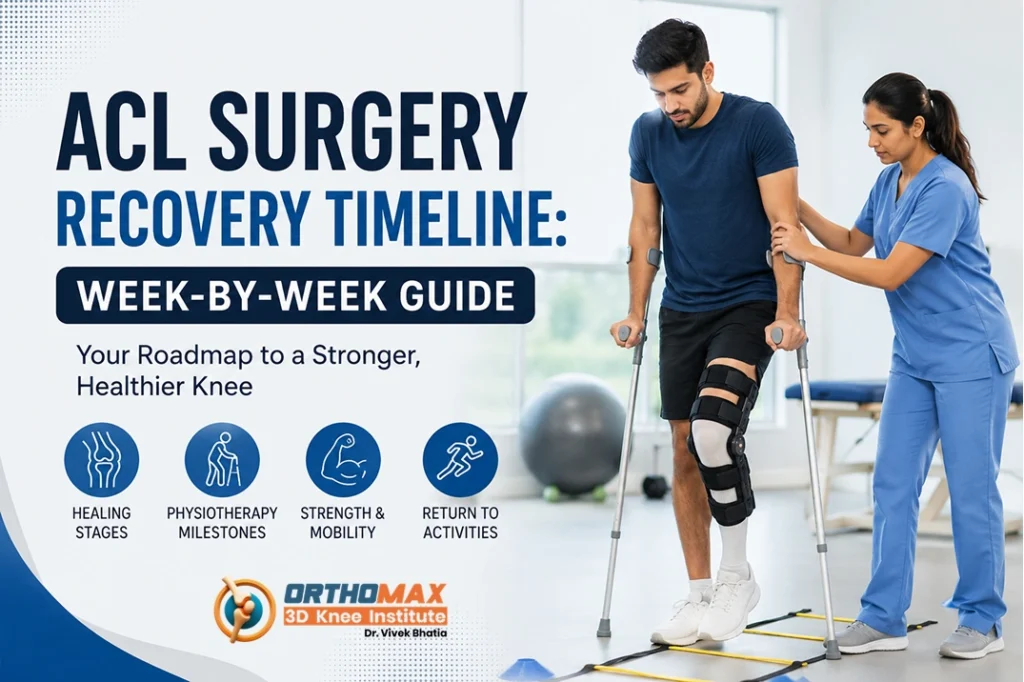
ACL Surgery Recovery Timeline: Week-by-Week Guide
ACL Surgery Recovery Timeline: Week-by-Week Guide The acl surgery recovery week by week guide is essential for anyone undergoing knee surgery ACL reconstruction and wanting a structured, predictable healing journey. The acl surgery recovery timeline is not the same for every patient, but it generally follows a scientifically proven rehabilitation pattern based on tissue healing, physiotherapy progress, and knee stability recovery after knee surgery. In India, ACL injuries are increasingly common due to sports activities like cricket, football, gym training, and road accidents leading to knee surgery cases. According to orthopedic clinical reports, ACL reconstruction patients who follow a guided rehabilitation program after knee surgery recover 25–35% faster than those who do irregular or self-managed recovery. This detailed guide explains every stage of healing after knee surgery ACL reconstruction so patients, caregivers, and athletes can understand what to expect week by week. What Happens After ACL Surgery? ACL (Anterior Cruciate Ligament) reconstruction involves replacing the torn ligament with a graft from the hamstring tendon, patellar tendon, or quadriceps tendon. The biological healing process includes: Initial graft fixation (0–2 weeks) Early ligament integration (3–12 weeks) Remodeling phase (3–9 months) Full maturation (9–12 months) The complete acl surgery recovery timeline typically spans 9 to 12 months, but functional improvement begins much earlier. Week 1–2: Protection & Pain Control Phase This is the most critical stage of the acl surgery recovery week by week guide. Goals: Control pain and swelling Protect the surgical graft Prevent stiffness Begin gentle movement What Patients Experience: Moderate to high swelling in the knee Difficulty in walking without support Use of crutches and knee brace Limited knee bending (0–60° range) Physiotherapy: Quadriceps isometric contractions Ankle pump exercises Passive knee extension Ice therapy (3–5 times daily) Medical Insight: Studies show that early controlled motion reduces post-surgical stiffness by up to 40% compared to immobilization. Week 3–4: Early Mobility Phase This phase marks the beginning of functional recovery in the acl surgery recovery timeline. Goals: Improve knee range of motion Reduce swelling further Begin partial weight-bearing Progress: Knee bending improves up to 90° Crutch dependency reduces Walking becomes more stable Exercises: Heel slides Straight leg raises Mini squats with support Stationary cycling (low resistance) Recovery Insight: By the end of week 4, around 60–70% of patients regain partial independent walking ability, depending on rehab consistency. Week 5–8: Strength Building Phase This is one of the most important stages in the acl surgery recovery week by week guide, where strength rebuilding begins. Goals: Restore muscle strength Improve balance Achieve near full knee motion Progress: Knee flexion reaches 120–130° Swelling reduces significantly after activity Crutches are usually discontinued Physiotherapy: Resistance band exercises Step-ups and step-downs Balance board training Controlled squats Data Insight: Quadriceps strength can improve by 25–35% during this phase with structured physiotherapy. Week 9–12: Functional Recovery Phase At this stage, the acl surgery recovery timeline shifts toward functional independence. Goals: Normalize walking pattern Build endurance Improve coordination Activities: Brisk walking Light jogging (if approved) Functional training Exercises: Lunges Single-leg balance drills Core strengthening workouts Recovery Insight: Most patients regain 70–80% functional knee stability by 12 weeks, depending on graft type and rehab adherence. Month 4–6: Advanced Strength Phase This stage is crucial for athletes and active individuals following the acl surgery recovery week by week guide. Goals: Regain explosive strength Improve agility and speed Prepare for sports-specific movement Training Includes: Jogging progression to running Plyometric jumps Agility ladder drills Direction change training Medical Insight: Return-to-run programs generally begin at 16–20 weeks post-surgery under medical supervision. Month 6–9: Sports Preparation Phase This is a high-intensity phase in the acl surgery recovery timeline. Goals: Restore near-normal athletic ability Improve neuromuscular control Prevent reinjury Training: Sprint drills Sport-specific training Advanced plyometrics Reaction drills Recovery Insight: Only 65–75% of patients return safely to competitive sports within 9 months, highlighting the importance of controlled progression. Month 9–12: Full Recovery Phase This is the final stage of the acl surgery recovery week by week guide. Goals: Full strength restoration Psychological confidence in knee use Return to competitive sports Outcome: Stable knee function Full range of motion Reduced reinjury risk (if rehab followed properly) Important Note: Even after full recovery, neuromuscular training reduces reinjury risk by up to 50%. Factors Affecting ACL Recovery in India The acl surgery recovery timeline may vary due to: Quality of physiotherapy services Patient age and fitness level Graft type used in surgery Early rehabilitation compliance Access to orthopedic follow-ups In India, structured rehab programs improve recovery speed by 20–30% compared to self-managed recovery. Common Mistakes to Avoid Many patients slow down their recovery due to: Skipping physiotherapy sessions Returning to sports too early Ignoring swelling or discomfort Overtraining in early phases Not using knee support properly Avoiding these mistakes is essential for a successful outcome in the acl surgery recovery week by week guide. FAQs 1. How long is ACL surgery recovery? The full acl surgery recovery timeline usually takes 9–12 months for complete recovery. 2. When can I walk after ACL surgery? Most patients walk without crutches within 3–6 weeks depending on progress. 3. When can I return to sports? Light sports may resume after 6 months, while competitive sports require 9–12 months. 4. Is physiotherapy mandatory? Yes, physiotherapy is essential throughout the acl surgery recovery week by week guide to restore strength and stability. 5. Can ACL tear happen again? Yes, reinjury is possible, especially if rehabilitation is not followed properly within the first year. Conclusion The acl surgery recovery week by week guide provides a structured roadmap for safe and effective healing after ACL reconstruction. The acl surgery recovery timeline is a gradual process that moves from pain management to full functional recovery over several months. Recovery is not just about healing the ligament—it is about rebuilding strength, balance, mobility, and confidence. Patients who follow disciplined physiotherapy, avoid early overloading, and stick to medical guidance have significantly better outcomes and lower reinjury rates. In India, where sports participation is increasing rapidly, awareness of structured ACL rehabilitation is